


 Log in
 Log out
Tropical Storm Bertha
Status: Closed
| Type of posting | Posting date(EST): | Summary | Downloads |
|---|---|---|---|
| Pre-Landfall 2 | 8/4/2014 1:40:00 PM |

|
|
| Pre-Landfall 1 | 8/1/2014 12:30:00 PM |
|
Pre-Landfall 1 | Summary
Posting Date: August 1, 2014, 12:30:00 PM
Tropical Storm Bertha, which became the second named storm of the Atlantic hurricane season late yesterday evening local time, is anticipated to pass near Barbados and through the Lesser Antilles on Friday, and continue into the northeastern Caribbean on Saturday, August 2. A United States Air Force Reserve Hurricane Hunter aircraft investigated the system this morning and reported that the storm has strengthened slightly overnight, but remains disorganized.
Current Conditions and Forecast Track
As of 11 a.m. Atlantic Standard Time (15:00 UTC), Friday, August 1, Tropical Storm Bertha is located about 70 miles (110 kilometers) northeast of Barbados. With maximum sustained winds of 50 mph (85 km/h)—as well as gusts of up to 63 mph (102 km/h)—and a minimum central pressure of 1008 millibars, Tropical Storm Bertha is moving west-northwest at a forward speed of 21 mph (33 km/h) and is anticipated to pass north of Barbados over the next several hours. By late Friday, Bertha is expected to move through the central Lesser Antilles, and progress into the northeastern Caribbean by Saturday, August 2. The National Hurricane Center reports that Bertha is not expected to significantly strengthen or weaken during the next 48 hours.
Currently, tropical storm conditions are anticipated by noon on Friday in St. Lucia, Dominica, Martinique, Vieques, and Culebra. Tropical storm conditions are expected in Puerto Rico, the U.S. Virgin Islands, and the British Virgin Islands on Saturday. Bertha is currently forecast to produce 1-3 inches of rain in most of the regions at risk; however, in isolated portions of the Leeward Islands, Puerto Rico, and the Virgin Islands, rainfall of up to 6 inches may occur.
Exposure at Risk
Buildings in parts of the Caribbean region exhibit moderate to high vulnerability to tropical cyclones, largely as a result of a lack of code enforcement rather than an insufficient code. However, there is a wide range in building code type, utilization, and enforcement across the Caribbean, even though commercial building types and residential building stock are similar.
For example, in the Bahamas and Bermuda, vulnerability is relatively low due to both strong building codes and rigorous code enforcement. In Puerto Rico, a large percentage of residential homes are made of reinforced concrete and are thus highly resistant to wind damage. Puerto Rico also has relatively high building code enforcement, which reduces building vulnerability. In contrast, islands with low or minimal building regulation enforcement, and thus higher vulnerability to tropical cyclone wind and rain, include Grenada, Haiti, Trinidad and Tobago, St. Lucia, St. Kitts and Nevis, Jamaica, and Barbados.
In Barbados, most structures are of masonry construction, and these buildings exhibit varying vulnerability due to differences in building quality and adherence to building codes. Reinforced concrete apartments and condominiums on this island were likely constructed with some level of engineering attention, reducing their vulnerability to moderate winds.
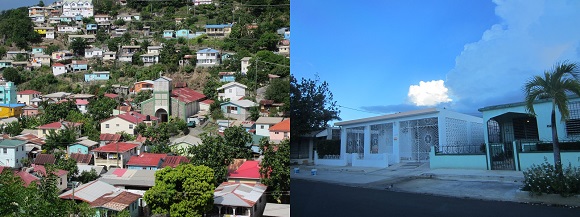
Left: Vulnerable light metal roofs are prevalent in St. Lucia. (Source: AIR)
Right: Robust concrete “bunker” construction is prevalent in Puerto Rico. (Source: AIR)
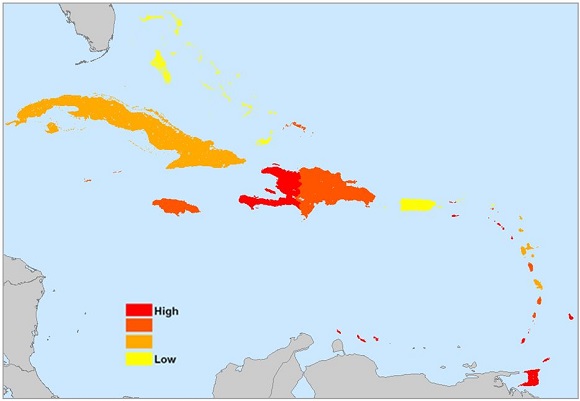
Tropical cyclone vulnerability for modeled countries and territories in the Caribbean region (Source: AIR)
Possible Impacts in the Caribbean Region
The wind speeds and rainfall currently being produced by Tropical Storm Bertha are not anticipated to cause much damage to well-constructed buildings. These winds could, however, test vulnerable roof materials such as light metal roofing panels, or weakly attached wall siding. Poorly constructed shanty-type homes may see more significant damage from heavy rains as well as from wind, but these structures would likely be uninsured.
If severe localized flooding does occur, weaker construction types such as timber or unreinforced masonry will be the most vulnerable. In addition, contents damage could occur if walls made from these materials are compromised by flooding. Automobile exposures are also particularly vulnerable to flooding.
AIR will continue to monitor the system as it moves through the Caribbean region and will post updates as warranted.